
The Hidden Cost of Truck Rolls: 6 Reasons Your Distributed Network Is Bleeding Budget (and How to Fix It)
Cy
If you manage a DOOH or retail media network, truck rolls are part of the job. Screens go dark, connectivity drops, hardware ages out. Someone eventually has to go onsite, and that’s normal.
But there’s something worth sitting with about that cost, and it’s that a truck roll is never really one fixed number. What it actually costs depends on what the technician finds when they get there. A quick reboot that takes ten minutes onsite is a very different expense than a fault that takes a couple of hours to isolate, or one that needs a second trip because the first visit didn’t fully resolve it. And a truck roll almost never happens in isolation. The real cost at any given location shows up over a month or a quarter, once you count how often that same site needs a visit, not just what a single dispatch runs.
That’s the piece that’s easy to miss when a truck roll gets treated as a flat, predictable cost. It isn’t one. It’s a rolling, variable expense that depends on the problem, how long the technician is onsite, and how frequently that location needs help in a given stretch of time. A remote management layer, by comparison, is priced as a fixed, predictable cost per location per month, one that’s typically less than what even one or two truck rolls to that same site would run. Remote management doesn’t take every visit off the schedule, since some issues are genuinely hardware and need hands-on-site. Still, it’s built to handle the connectivity and uptime issues that don’t, so a technician only gets dispatched when a visit is truly the only path to a fix.
At the same time, the revenue riding on those screens keeps climbing. Global retail media spend is projected to cross $196 billion in 2026, with in-store and connected screens increasingly recognized by the IAB as a formal media channel alongside audio and QR-enabled activations. Roughly three-quarters of purchases still happen in a physical store, and a meaningful share of shoppers report buying something specifically because of what they saw on a screen. Every hour a display sits dark isn’t just a maintenance line item. It’s a missed impression, a missed sponsorship delivery, and in some cases a missed transaction.
That’s the real reason truck rolls deserve a closer look. Not because dispatching a technician is a mistake, but because a portion of the dispatches happening across the industry today are solving problems that could have been caught, and often resolved, before a truck ever left the lot.
For distributed networks, whether retail media screens, kiosks, or DOOH, the gap between a network that scales cleanly and one that strains under its own growth usually comes down to one variable: how many issues get resolved remotely versus how many require a person standing at the device.
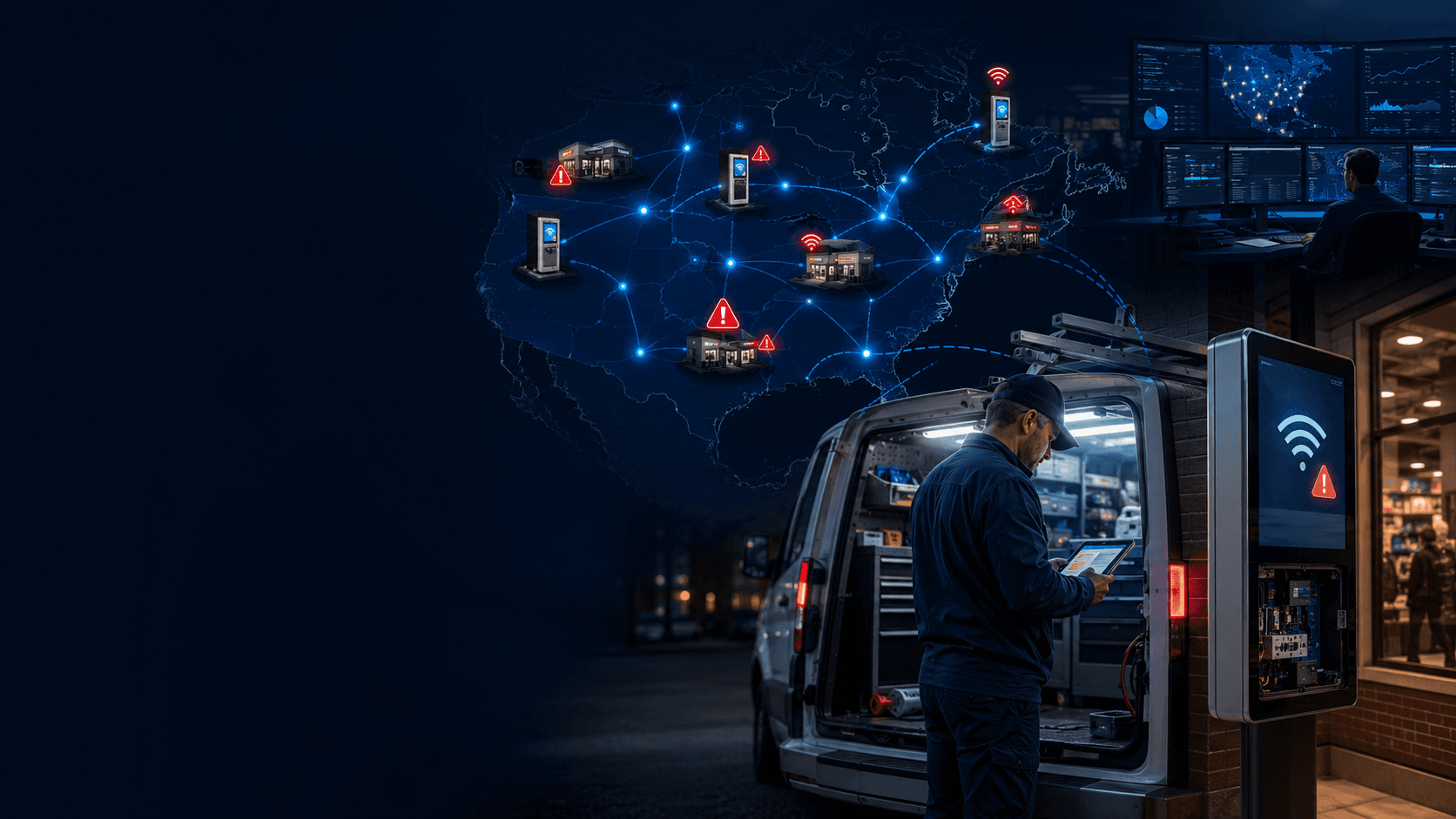
1. Diagnosis Takes Longer Without Visibility Into the Edge
The most expensive truck roll isn’t the one that fixes something. It’s the one sent to find out what’s wrong in the first place. When a screen goes offline, there are several possible causes, and they don’t announce themselves:
- A carrier outage or degraded signal in that specific location
- A SIM that’s hit a data cap or lost provisioning
- Router configuration drift after a firmware update
- A power interruption at the site
- A media player or CMS fault unrelated to connectivity at all
- Local interference from other equipment sharing the same power or network drop
Without live visibility into the connectivity layer, a support team is often troubleshooting blind, and the safest call is frequently to dispatch someone to look. By the time a technician arrives and runs diagnostics onsite, the cause is often something that live monitoring would have surfaced in minutes.
The cost isn’t limited to the visit itself. It’s the delay in identifying root cause, the extended downtime on a screen that may be mid-flight on a paid sponsorship, and the fact that a skilled technician’s time gets spent confirming a diagnosis rather than doing higher-value work.
This is why remote diagnostics across the connectivity, hardware, and application layers has become a baseline expectation rather than an add-on for networks operating at scale. The more of the stack you can see from a dashboard, the fewer visits start with “let’s see what’s going on.”
2. Network Ownership Shapes How Fast You Can Act
Some DOOH and retail media deployments run on infrastructure that’s owned and managed by a carrier, a venue, or a legacy integrator. That model has real advantages: it’s often simpler to stand up initially, and it shifts day-to-day maintenance to someone else.
It also comes with a structural tradeoff. When the routers, SIMs, and monitoring layer belong to a third party, your own team’s access to diagnostics, carrier switching, and configuration changes runs through that partner’s process and timeline. That’s not a flaw in the model; it’s simply how a managed arrangement works, and for smaller or simpler deployments it can be the right fit.
For larger, revenue-critical networks, though, operators increasingly find value in owning more of the stack directly, meaning their own routers, their own SIM strategy, and their own management platform. Direct ownership allows a team to:
- Diagnose issues in real time without waiting on a third-party escalation path
- Take immediate corrective action like a remote reboot, failover, or reprovisioning
- Standardize configurations across every location instead of inheriting whatever the prior integrator set up
- See the full picture of a device’s health rather than a partial view
As retail media networks scale past a few hundred locations and advertisers start expecting uptime guarantees tied to campaign delivery, the amount of direct control a team has over its own infrastructure becomes a meaningful factor in how quickly problems get resolved. Neither model is wrong. It’s a question of what level of control the size and revenue stakes of your network call for.
3. Carrier Diversity Adds Resilience to the Network Path
Single-carrier deployments are common, and for good reason: they’re straightforward to plan and manage. But carrier performance isn’t uniform. It varies by:
- Location (urban density versus rural coverage, indoor versus outdoor placement)
- Time of day and local network congestion
- Environmental factors like building materials and signal interference
When a location depends on one carrier, a local dip in signal or a temporary outage can take a screen offline even though nothing onsite has actually failed. From a support desk’s view, though, it often looks like a site issue, because the screen is dark and the location is fixed. That perception alone drives a share of dispatches toward locations where nothing onsite needed fixing at all.
That’s why multi-carrier and dual-SIM designs have become a common resilience layer in distributed networks, particularly ones spanning many geographies with variable coverage. Intelligent failover based on real performance, not just a binary up or down signal, along with the ability to switch carriers per preconfigured parameters rather than swap out a physical SIM, turns a good number of “site down” alerts into automated recovery events that never need a technician at all.
4. Remote Access Turns Field Jobs Back Into Desk Work
When a team can’t remotely reach and control edge devices, small fixes turn into field jobs by default. That includes things like:
- Rebooting a router or gateway
- Pushing a firmware or configuration update
- Resetting a SIM session
- Adjusting a network setting
- Pulling logs for troubleshooting
None of these are complicated tasks on their own. Without remote access, though, each one requires a person physically at the device, which is a significant amount of overhead for what’s often a five-minute fix.
Centralized remote management platforms, capable of reaching thousands of endpoints at once, have become standard infrastructure for networks of any real size. That typically includes secure remote access to routers and connected hardware, configuration management applied consistently across locations, real-time monitoring and alerting, and visibility into each device’s lifecycle. In a DOOH or retail media context, where screens are geographically spread out and usually unattended, this kind of remote reach isn’t a convenience feature. It’s what makes managing hundreds or thousands of locations with a lean team possible at all.
5. Manual Processes Get Harder to Sustain as Networks Grow
A reactive, manual troubleshooting workflow tends to look something like this: an issue gets reported, a technician or support agent starts investigating, several systems get checked one at a time (CMS, connectivity, hardware), the root cause takes a while to pin down, and a truck roll gets scheduled to be safe.
That process works fine at a small scale. As a network grows into the hundreds or thousands of locations, though, manual troubleshooting tends to introduce more variability: outcomes depend heavily on which agent picks up the ticket, resolution times stretch out, and dispatch becomes the default answer when there isn’t a fast way to rule out a remote fix.
Automation addresses this less by replacing people and more by giving them better information faster. That typically looks like:
- Unified monitoring that pulls network, device, and application data into one view
- Automated alerts tied to specific, known failure conditions rather than a generic “offline” flag
- Standardized troubleshooting runbooks so outcomes don’t depend on which agent is on shift
- Integration between monitoring tools and the ticketing system so context travels with the ticket
With that in place, a support team can usually tell within minutes whether an issue needs a physical visit or can be cleared remotely, which keeps the operating model scalable as the location count climbs.
6. Tracking Truck Roll Prevention Tells a Fuller Story Than Cost Per Dispatch
Many organizations track truck rolls primarily as a cost line: number of dispatches, cost per dispatch. Those numbers matter, but on their own they measure the symptom rather than the cause. A more complete picture usually includes:
- Percentage of incidents resolved remotely
- Mean time to detect and resolve an issue
- Repeat incidents at the same location
- The split between connectivity-related and hardware-related failures
- Uptime and revenue impact per screen, especially for locations carrying paid sponsorship or promotional content
Looking at these metrics together tends to surface a pattern: a portion of truck rolls across most networks are ones that better visibility or remote access could have resolved without a visit. Operators who treat truck roll prevention as part of network architecture and ownership decisions, not just a field service efficiency project, generally see that pattern shrink over time.
This is also where the fixed-versus-rolling distinction pays off in practice. A location with recurring issues doesn’t rack up one truck roll cost; it racks up several, and each one carries its own variables of problem type, time onsite, and whether a follow-up visit is needed. That rolling total is genuinely hard to forecast or budget against. A remote management program sidesteps that unpredictability by design: it’s a fixed cost per location per month, set below the cost of even one or two truck rolls to that site, and its entire job is to absorb as much of the connectivity and uptime troubleshooting as possible so those rolling, variable dispatch costs don’t accumulate in the first place. Framed that way, the choice isn’t remote management instead of field service. It’s remote management as the layer that keeps field service reserved for the visits that genuinely need a technician standing at the device.
Truck Rolls Should Be a Deliberate Choice, Not the Default Answer
Truck rolls aren’t going away, and they shouldn’t. Hardware fails. Screens get damaged. Power goes out. Those are legitimate, unavoidable reasons to send someone onsite.
The opportunity is in the dispatches sent to reboot equipment, troubleshoot connectivity, switch carriers, diagnose an unclear issue, or push a configuration change. Those are the categories where better visibility, more direct control, and stronger remote management tend to close the gap between “we don’t know what’s wrong” and “we already fixed it.” For DOOH and retail media operators, that usually comes down to a combination of factors: how much of the network stack you control directly, how resilient the connectivity design is across carriers, and how much can genuinely be done from a dashboard instead of a truck.
As retail media spend continues its climb toward $200 billion globally in 2026 and screens carry more direct revenue responsibility than ever, the value of keeping a location broadcasting and transacting continuously is only going up. Getting ahead of avoidable downtime isn’t about eliminating truck rolls. It’s about making sure the ones that happen are the ones that actually need to.