
6 Reasons DOOH and Retail Media Networks Should Control Their Own Connectivity Infrastructure
Cy
If you operate a DOOH or retail media network, you already know that an offline screen is rarely just an IT issue. It can mean missed impressions, incomplete campaigns, lost transactions, frustrated retailers, and uncomfortable conversations with advertisers.
The challenge is that many screen networks still depend on connectivity they do not manage or control. That may be a retailer’s shared Wi-Fi network, a local internet provider, or a collection of different vendors across hundreds of locations. Everything may work well when the network is small. As the footprint grows, however, the cracks begin to appear.
One location changes its Wi-Fi password. Another experiences poor coverage. A router goes offline without anyone noticing. A campaign underdelivers, and the operations team has to work backwards to determine what happened. This is why more DOOH and retail media companies are taking greater control of the infrastructure behind their screens.
That does not necessarily mean becoming a telecommunications provider or building every part of the network internally. It means having a dedicated connectivity strategy, clear visibility, defined service levels, and the ability to respond without depending entirely on someone else.
Here are 6 reasons why DOOH and Retail Media Networks Should Control Their Own Connectivity Infrastructure.
1. You protect the revenue that depends on screen uptime
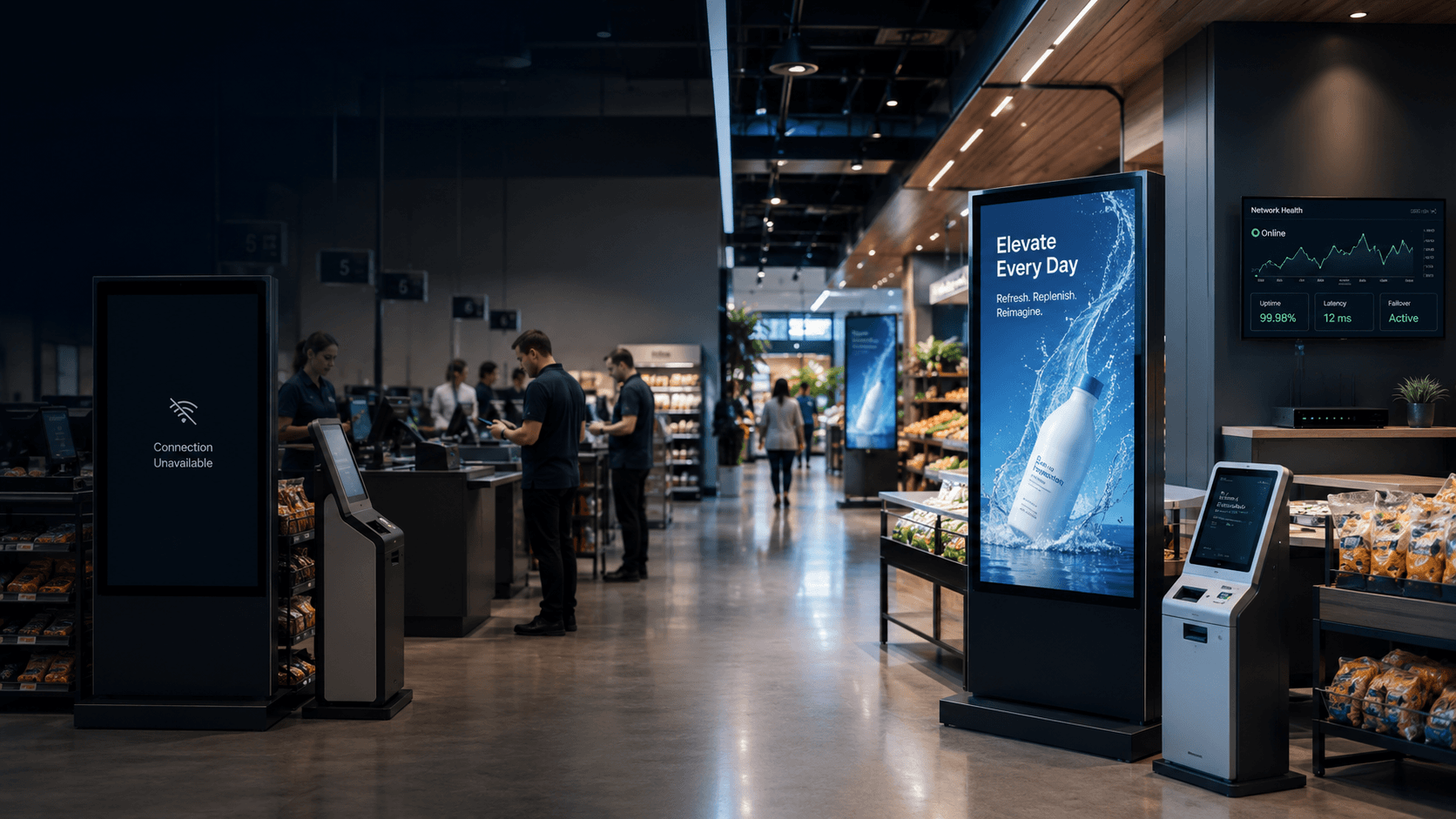
Every screen represents an opportunity to deliver an impression, influence a purchase, or complete a transaction. When the screen goes offline, that opportunity disappears.
The content may be scheduled correctly. The campaign may have been sold. The advertiser may be expecting delivery. But none of that matters if the connection behind the screen is unavailable.
Controlling your connectivity infrastructure allows you to build the network around the actual needs of your screen footprint. That may include:
- Primary cellular or wired connectivity
- Automatic failover between carriers or connections
- Enterprise-grade routers at each location
- Remote monitoring and alerts
- Usage controls and performance reporting
- Clear escalation and support procedures
Instead of accepting the same generic internet setup at every location, you can design connectivity based on the importance, traffic, coverage, and revenue potential of each site. This becomes even more important in programmatic DOOH and retail media. Advertising decisions, content updates, proof-of-play records, and reporting often happen in near real time.
A campaign cannot generate value if the infrastructure needed to deliver it is unreliable.
2. You maintain control when something goes wrong
Every network experiences issues. The real difference is how quickly the problem is detected, understood, and resolved. Without direct network visibility, troubleshooting often begins with a long list of questions.
- Is the screen powered on?
- Is the media player working?
- Did the retailer change something?
- Is the local internet connection down?
- Is the cellular signal weak?
- Is the problem affecting one screen, one store, or an entire region?
When several different vendors are involved, each provider may only see one part of the problem. Your team is left coordinating the investigation while the screen remains offline.
A controlled network gives you a much clearer picture. You can see when a location lost connectivity, whether a secondary connection activated, how long the disruption lasted, and whether the issue is isolated or widespread.
That clarity helps your team respond with confidence. Instead of telling a retailer or advertiser: “We are still trying to find out what happened,” you can provide a more useful update: “We detected a connectivity issue at the location, traffic transitioned to the backup connection, and the screen remained operational.”
That kind of response protects more than uptime. It protects your reputation.
3. You give advertisers proof, not assumptions
Advertisers are becoming more demanding about campaign accountability, and understandably so. They want to know whether their campaign ran, where it ran, how long it was available, and whether any interruptions affected delivery.
Proof-of-play reporting is an important part of that conversation, but it does not always tell the complete story. A media player may record that content was scheduled or played while a screen was unavailable, disconnected, powered off, or experiencing another issue at the location.
Connectivity and device-health data add another layer of confidence. When your network has direct visibility into screen and location availability, you can connect operational performance with campaign reporting. That can help answer questions such as:
- Was the location connected during the campaign window?
- Were there any periods of downtime?
- Did the connection fail over successfully?
- Was the problem limited to one location?
- How quickly was service restored?
- Could the issue have affected campaign delivery?
This does not mean promising that nothing will ever fail. It means being able to show what happened when something did.
That transparency can strengthen advertiser trust, support more meaningful service-level agreements, and make campaign conversations easier when performance is questioned. In a market where many networks offer similar audiences and inventory, operational reliability can become a real competitive advantage.
4. You can scale without inheriting unnecessary complexity
Connectivity is often treated as a small part of a screen deployment until the network grows. A few locations can be managed manually. A few different internet providers may not create much concern. Someone can call a store when a screen stops reporting. That approach becomes much harder at 100, 500, or 1,000 locations.
At scale, small inconsistencies become operational problems. One retailer provides Wi-Fi. Another requires cellular connectivity. Some locations have strong carrier coverage, while others need a different provider. Hardware configurations vary. Support responsibilities are unclear. Billing is spread across multiple vendors. Eventually, the network becomes difficult to manage because no one has a complete view.
A standardized connectivity strategy can simplify that growth. You can establish approved hardware, preferred carrier options, consistent configuration policies, defined alerting rules, and a repeatable deployment process. Your team no longer has to reinvent the network for every new location. They can choose the right connection for the site while managing the overall footprint through one operating model.
That makes it easier to add new retailers, enter new markets, support different screen formats, and respond when the business wants to move quickly. Growth should not depend on whether someone can locate the local Wi-Fi password.
5. You reduce security and third-party risk
Retail media and DOOH screens are part of a much larger connected environment. They may include routers, media players, displays, sensors, cameras, content platforms, remote-management tools, and third-party applications.
Every connection adds another potential point of exposure. When a screen network relies on shared or unmanaged connectivity, it can become difficult to understand who has access, how traffic is separated, whether devices are properly secured, and how changes are tracked.
Greater control over the network layer allows operators to apply more consistent security policies. That may include:
- Network segmentation
- Firewall and access-control policies
- Encrypted connections
- Controlled remote administration
- Device and router configuration standards
- User access logs
- Firmware and security updates
- Alerts for unusual activity or configuration changes
This is especially important when screens operate inside retail, financial, healthcare, transportation, or other sensitive environments. Retailers and advertisers want to know that the technology operating inside their locations is being managed responsibly. Security cannot be added only after an incident occurs. It needs to be part of the connectivity and device strategy from the beginning.
6. You can retain control without building everything yourself
There is an important distinction between controlling your network and operating every part of it internally. Building an internal connectivity operation requires carrier relationships, hardware expertise, deployment resources, monitoring tools, security processes, billing systems, and ongoing technical support.
For many DOOH and retail media networks, creating all of that from scratch would take attention away from the areas where they create the most value. Their teams should be focused on growing the network, attracting advertisers, building retailer partnerships, improving content, and creating better customer experiences. This is why the market is moving toward specialized operational partners that can support:
- Connectivity provisioning
- Multi-carrier coverage
- Primary and backup connections
- Enterprise router deployment
- Remote monitoring and alerting
- Device and location visibility
- Security support
- Usage management
- Technical escalation
- Ongoing managed services
The strongest approach is often a hybrid model.The DOOH or retail media operator maintains strategic control over its data, service expectations, advertiser relationships, and customer experience. A specialized partner manages the day-to-day complexity behind the network. That gives the operator the benefits of control without needing to hire an entire telecommunications and network-operations team.
What controlling the network really means?
Controlling your network does not necessarily mean owning every cable, cellular tower, router platform, or monitoring system. It means knowing who is responsible, having access to the right information, and being able to make decisions without relying on assumptions.
A well-controlled network should give you clear answers to a few basic questions:
- Which locations are online right now?
- Which locations are operating on backup connectivity?
- Where are recurring problems happening?
- How long has a screen or location been unavailable?
- Who is responsible for responding?
- What impact could the issue have on campaign delivery or transactions?
- Can the problem be addressed remotely?
- Is there enough data to explain the incident to the advertiser or retailer?
If those questions are difficult to answer, the network may be running, but it is not truly under control.
The bottom line
DOOH and retail media networks are being asked to deliver more. More screens. More locations. More programmatic campaigns. More reporting. More accountability. More uptime. The infrastructure behind those screens has to grow with those expectations.
Networks that control their connectivity and operational infrastructure are better positioned to protect campaign revenue, maintain retailer confidence, support advertiser transparency, improve security, and scale without creating unnecessary operational chaos. The goal is not simply to keep a screen connected. The goal is to know that the screen is available, understand when it is not, and have a reliable process for getting it back online before a small issue becomes a larger business problem.
For network operators, the question is worth asking: Are we actively controlling the infrastructure that supports our revenue, or are we relying on infrastructure that was never designed around our business?
The answer will influence how reliably, confidently, and quickly the network can grow.