
11 Retail Media Trends in 2026 That Are Quietly Reshaping In-Store Advertising Revenue
Cy
Retail Media has quietly become one of the most valuable advertising channels in the digital landscape: it isn’t just growing, it’s evolving fast. In 2026, brands are no longer thinking about retail media as a “nice-to-have” add-on to ecommerce. It’s becoming a core part of advertising strategy, especially as in-store experiences become more digitized.
Here’s what’s driving that shift:
- The retail media market is projected to reach $203.9 billion globally in 2026.
- In-store media now contributes 10–40% of total retail media network revenue.
- Over 76% of purchases still happen in physical stores.
- The lines between DOOH (Digital Out-of-Home) and retail media are disappearing.
What used to be simple screens playing looping content has turned into something much bigger: a real-time, data-driven, revenue-generating ecosystem.
Below are 11 Retail Media Trends in 2026 That Are Quietly Reshaping In-Store Advertising Revenue and, more importantly, what they mean for revenue.
1. Retail Media Is No Longer Just E-commerce
Retail media started with sponsored products online. Now, it’s full-funnel.
Brands are using retail media not just to drive clicks, but to:
- Build awareness
- Influence decisions in-store
- Drive immediate purchases
In-store screens are playing a major role here. A shopper walking down an aisle can now:
- See a product
- Be influenced by a screen
- Make a purchase within seconds
That’s something e-commerce alone can’t replicate.
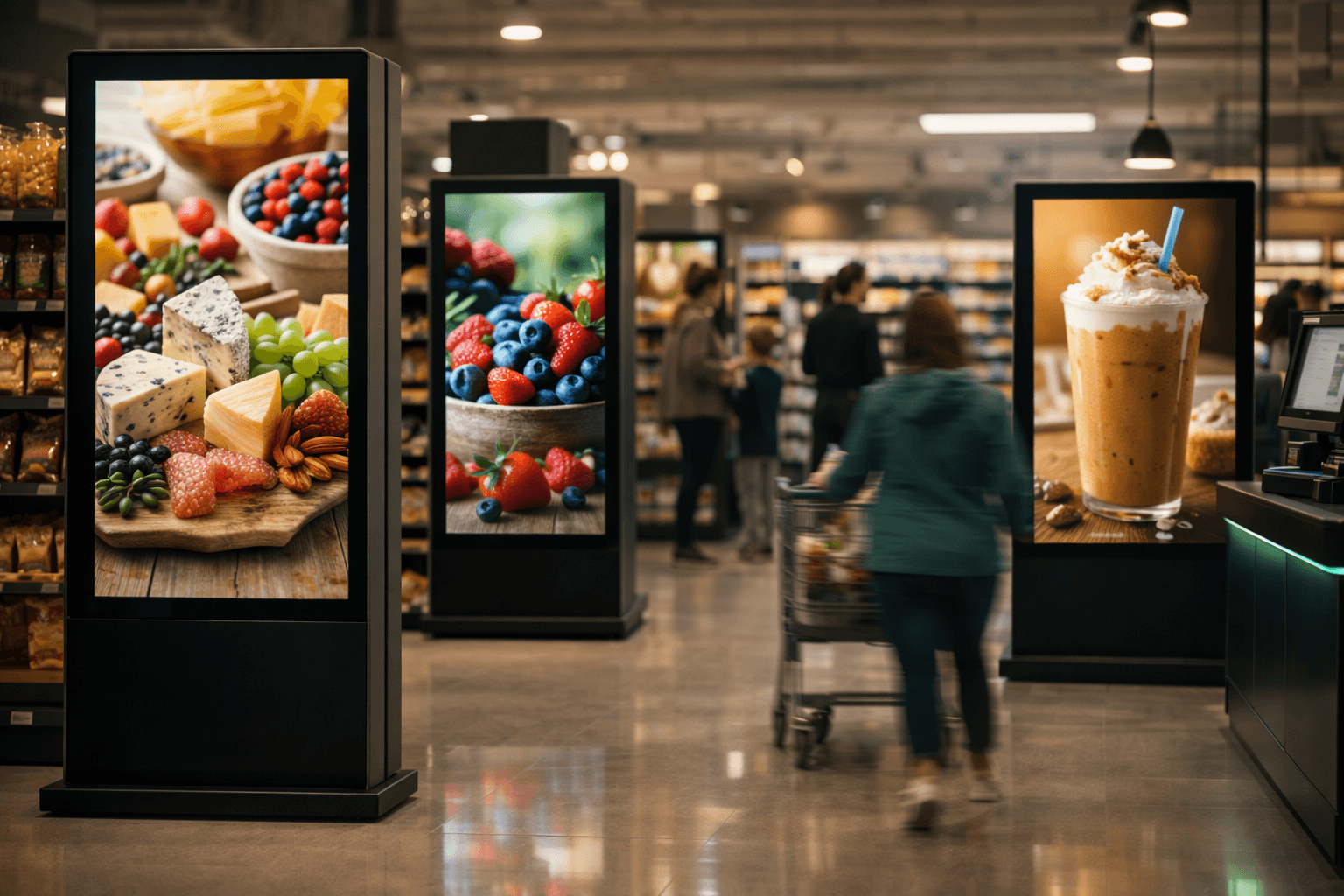
2. In-Store Screens Are Becoming Premium Inventory
Not all impressions are created equal. In 2026, brands are paying more for:
- Where the screen is located
- When the ad is shown
- What the shopper is doing in that moment
High-value placements include:
- Endcaps
- Freezer doors
- Checkout lanes
These are decision moments, and advertisers know it. That’s why in-store screens are now treated as premium inventory, not just filler media.
3. Programmatic Is Moving Into Physical Stores
Programmatic advertising has moved beyond digital screens at home and on mobile devices. It’s now happening inside stores.
This means:
- Ads are bought and sold in real time.
- Campaigns adjust automatically based on conditions.
For example:
- A cold drink ad runs on a hot day.
- A promotion activates when inventory is high.
- Messaging changes based on time of day
This shift transforms retail media into something dynamic. But it also introduces one key dependency: continuous, reliable connectivity.
4. First-Party Data Is Driving Everything
Retailers have something most platforms don’t: actual purchase data. Not clicks, not impressions, but real transactions.
This allows brands to:
- Target audiences more accurately
- Understand buying behavior
- Measure campaign impact directly
As third-party cookies are phased out, this data becomes even more valuable. That’s why budgets are shifting toward retail media networks.
5. Advertisers Expect Closed-Loop Measurement
In 2026, advertisers aren’t guessing anymore. They want to know:
- Who saw the ad
- What they bought
- Whether the campaign worked
This is called closed-loop measurement. Retail media makes this possible because it connects:
- Ad exposure
- Purchase data
- Customer behavior
The result: campaigns are judged on real ROI, not vanity metrics like impressions alone.
6. Proof of Play Is Becoming Non-Negotiable
Advertisers are asking tougher questions:
- Did the ad actually run?
- Where did it run?
- How many times was it delivered?
This is known as proof of play. And it’s becoming a requirement. Without it:
- Campaigns may not be billable.
- Trust breaks down.
- Revenue is at risk.
This is especially important in programmatic environments where ads are bought automatically.
7. DOOH and Retail Media Are Converging Fast
Retail media and DOOH used to be separate. Not anymore. In 2026:
- In-store screens are part of broader DOOH networks.
- Campaigns can run across multiple environments.
- Brands can scale messaging beyond a single retailer.
This convergence creates:
- More reach
- More flexibility
- More revenue opportunities
But it also increases complexity.
8. AI Is Optimizing Campaigns in Real Time
Artificial intelligence is now deeply embedded in retail media. It’s used to:
- Adjust budgets automatically
- Optimize campaign performance
- Personalize creative
For example:
- If a campaign is underperforming, budget shifts instantly.
- If a product is selling well, ads increase exposure.
- Creative updates based on audience behavior
This makes campaigns more efficient, but again, it depends on one thing: real-time data flow
9. Advertisers Are Paying for Performance, Not Presence
There’s a major mindset shift happening. It’s no longer: “The screen is on, so the ad is running.” It’s now: “Did this campaign actually deliver results?”
Advertisers care about:
- Conversions
- Sales lift
- Engagement
If performance drops, budgets move quickly. That means networks can’t rely on visibility alone. They need consistent delivery.
10. Networks Are Scaling Faster Than Infrastructure
This is where things get interesting. Retail media networks are growing fast:
- Hundreds of screens → thousands
- Single locations → nationwide rollouts
But infrastructure doesn’t always keep up. Common challenges:
- Connectivity inconsistencies
- Network congestion
- Limited monitoring
At a small scale, these issues are manageable. At a large scale, they become revenue problems.
11. Uptime Is Becoming Revenue Infrastructure
This is the shift most people don’t see. Everything we’ve talked about--programmatic, AI, proof of play--all depends on one thing: Connectivity Uptime. If a screen disconnects, even briefly:
- Programmatic bids don’t come through.
- Ads fail to load.
- Proof of play may not register.
And the tricky part? Nothing looks broken. The screen is on. Content may still appear. Everything looks “fine.” But behind the scenes:
- Revenue opportunities are missed.
- Campaign performance drops.
- Reporting becomes inaccurate.
Now multiply that across hundreds or thousands of screens. That’s not a small issue. That’s lost revenue at scale.
Closing Take: Retail Media Is No Longer Just Media
Retail media in 2026 is no longer just about advertising. It’s about:
- Infrastructure
- Data
- Execution
The networks that win aren’t just the ones with the most screens. They’re the ones that can:
- Deliver consistently
- Measure accurately
- Optimize in real time
Because in today’s environment, it’s not enough for a screen to be on--it needs to be performing.
And increasingly, that performance comes down to something simple, but critical: reliable, always-on connectivity.